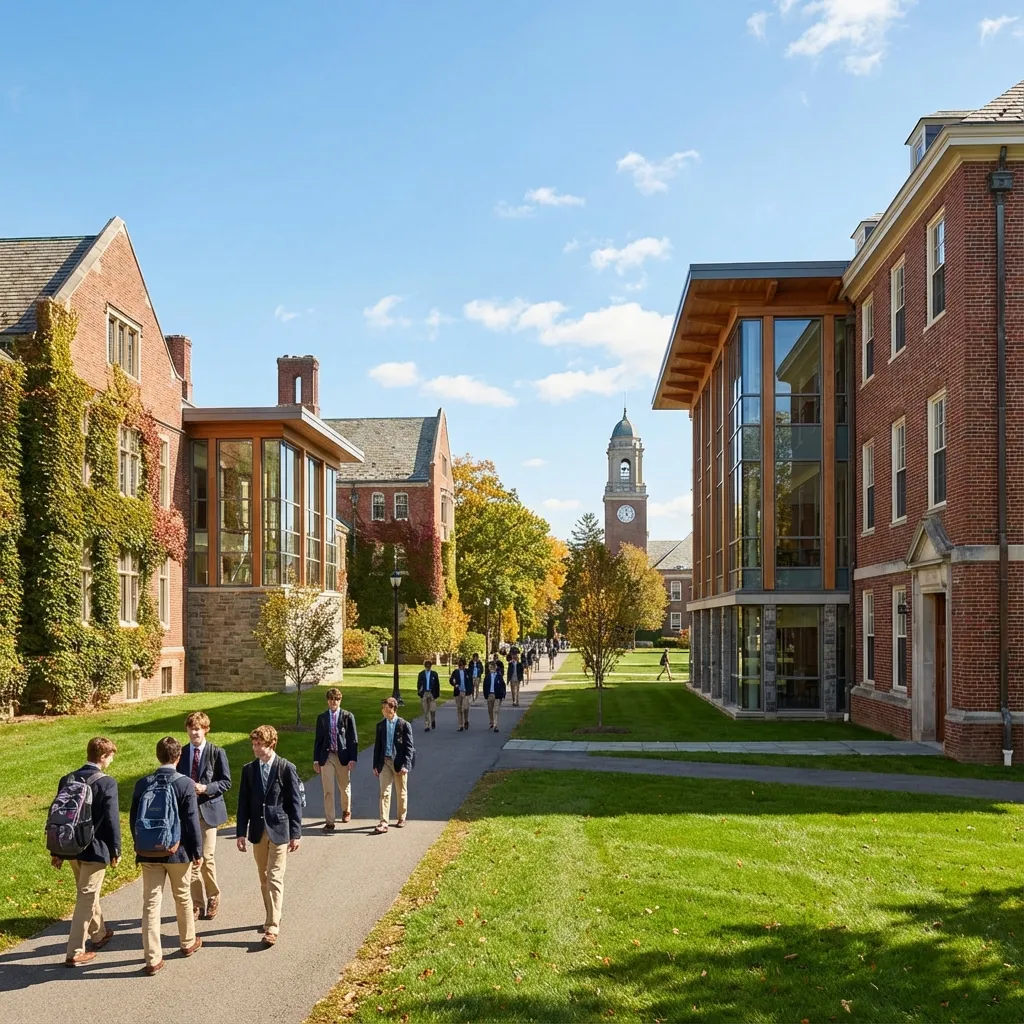
Strategic Admissions Dossier: Sidwell Friends School Middle School Division (Grades 5--8)
1. Executive Intelligence Briefing: The "Black Box" of Wisconsin Avenue
In the rarefied ecosystem of Washington, D.C. private education, Sidwell Friends School occupies a singular position that is frequently misunderstood by even the most astute parents and policy-makers. It is not merely an educational institution; it is a geopolitical entity, a potent social signifier, and a rigorous intellectual crucible wrapped in the deceptive velvet glove of Quaker humanism. For families targeting Middle School admission---specifically the pivot points of Grade 5, Grade 6, and Grade 7---the landscape is far more labyrinthine than the publicly available "Holistic Review" rhetoric suggests.^1^ The institution operates at the intersection of high-minded idealism and brutal meritocracy, creating a unique "Black Box" of admissions criteria that requires precise navigation.
This report serves as a comprehensive strategic dossier for the prospective family. Unlike the polished brochures that emphasize "letting one's life speak" or the joy of discovery, this document dissects what that life must actually say---and how it must be articulated---to gain entry into one of the most competitive day schools in the United States. We are analyzing an institution that maintains a reported acceptance rate hovering near a formidable 7% ^2^, a figure that rivals the Ivy League universities it heavily feeds. However, the Middle School admissions tunnel is even narrower than the aggregate statistics imply. With the vast majority of the student body already ensconced from the Lower School (Bethesda campus), the number of seats available for external applicants in Grades 5 through 8 is mathematically negligible, creating a hyper-competitive environment where "good" grades, "nice" extracurriculars, and standard parental advocacy are insufficient currency.^3^
The fundamental thesis of this intelligence report is that successful families must navigate what we term the "Quaker Paradox." Sidwell is an institution torn between two opposing, yet interconnected, identities:
-
The Egalitarian Spirit: A 350-year-old faith tradition ^4^ that insists on "that of God in everyone," radical equality, simplicity, and the rejection of titles, hierarchy, and ostentation.
-
The Elite Reality: A billion-dollar reputation as the "Harvard of Washington," the school of Presidents (Obama, Clinton, Biden grandchildren) ^5^, creating a "pressure cooker" academic environment ^6^ and a social hierarchy defined by extreme access, influence, and wealth.
The successful applicant---and significantly, their family---must master the art of code-switching between these two modes. You must be ambitious enough to survive the academic rigor that leads to engineering degrees and Ivy League matriculation ^5^, yet humble enough to respect the silence of the Meeting for Worship.^8^ You must be wealthy enough to afford the $59,440 tuition ^9^ and the ancillary costs of a Washington elite lifestyle, but "simple" enough to avoid ostentatious displays of consumption that trigger admissions red flags during the interview process. This report will guide you through that needle's eye, utilizing granular data to illuminate the path for the middle school applicant.
 {width="6.458333333333333in"
height="4.947916666666667in"}
{width="6.458333333333333in"
height="4.947916666666667in"}
2. Institutional Identity: Decoding the "Quaker Paradox"
To understand Sidwell Friends is to understand that it is not merely a school with a religious affiliation; it is a school with a philosophy that acts as a gatekeeper. Admissions officers are trained to sniff out "resume padding," inauthenticity, and values misalignments that conflict with Quaker testimonies. This is not a superficial branding exercise; it is the operating system of the school.
The SPICES Framework: The Rubric of Evaluation
The acronym SPICES is not just a mnemonic for students in the Lower School; it is the implicit rubric against which your family is evaluated during the admissions process.^4^ Understanding how these values translate into admissions criteria is critical for drafting essays and prepping for interviews.
-
Simplicity: This is perhaps the most dangerous trap for the Washington, D.C. elite. In the Quaker context, simplicity does not necessarily mean poverty or a lack of resources; it means a lack of clutter---both intellectual and material.^4^ It is about living with purpose and avoiding excess. In an admissions application, a resume that lists fifteen expensive summer camps, three private tutors, and a chaotic schedule of pay-to-play activities signals a lack of simplicity. It suggests a family that relies on accumulation rather than depth. The school values a student who focuses deeply on what matters, rather than one who is frenetically collecting accolades.
-
Peace: Conflict resolution and non-violence are central to the school's mission. A student with a history of playground dominance, bullying, or aggressive competitiveness will be flagged as a cultural mismatch. Similarly, a parent known for aggressive advocacy with teachers or a litigious approach to school administration will be viewed as a threat to the community's peace.^4^ The admissions committee seeks families who approach differences with dialogue, not demands.
-
Integrity: The honor code is paramount at Sidwell Friends. "Truth" is a capitalized concept in Quakerism. This goes beyond not cheating on a test; it extends to the authenticity of the application itself. Essays that are clearly written by consultants or parents, or financial aid applications that obfuscate assets, are violations of integrity that result in immediate rejection.^4^
-
Community: The collective supersedes the individual. The school seeks students who contribute to the community life, not just those who extract value from it.^10^ An applicant who frames their achievements solely in terms of personal gain ("I want to go to Sidwell to get into Harvard") is failing the "Community" test. The preferred narrative is one of contribution: "I want to go to Sidwell to engage in deep discussions that help the whole class learn."
-
Equality: This is the belief in the "equal worth of all people" and the rejection of artificial hierarchy.^4^ This is where the "Quaker Paradox" is most visible. While the student body includes the children of the most powerful people on the planet, the school culture insists that a 5th grader's voice in Meeting for Worship is as valid as the Head of School's or a Senator's child. An applicant who name-drops or relies on status to impress will alienate the admissions staff.
-
Stewardship: This testimony relates to the responsible use of resources and environmental care.^4^ It is not just about recycling; it is about an ethic of care for the world. Students who demonstrate a genuine, localized commitment to stewardship (e.g., maintaining a community garden, reducing waste at home) are viewed favorably compared to those who engage in performative, high-carbon-footprint service trips.
The Student Archetype: The "Thoughtful Intellectual"
Sidwell is not looking for the "obedient soldier" often associated with traditional prep schools, nor are they seeking the "radical activist" often associated with purely progressive schools. They seek the Thoughtful Intellectual.
-
Intellectual Humility: The ideal Sidwell student is brilliant but questions their own brilliance. They are comfortable with ambiguity and the "gray areas" of life. They do not just answer questions; they ask "Why does this question matter?" and "Who is affected by this answer?".^8^ The ability to listen deeply---a core Quaker practice---is prized over the ability to speak loudly.
-
The "Inner Light": This concept refers to the belief that every individual has a direct connection to the divine or to truth.^11^ In an admissions interview, a student who listens intently to others, builds on their ideas, and treats the interviewer as an equal partner in conversation is demonstrating respect for the other's "inner light." A student who interrupts to prove they are the smartest person in the room is failing the cultural test. The admissions committee is looking for students whose character, values, and actions already align with these principles, whether or not they have ever attended a Meeting for Worship.^4^
3. Middle School Realities: Grades 5--8
The Middle School years at Sidwell Friends represent a seismic shift in a student's educational journey. This is where the "warm cocoon" of the Lower School ends and the rigorous, college-preparatory "pressure cooker" begins. Understanding the physical and structural changes that occur during these years is essential for prospective families to gauge whether their child is ready for the transition.
The Campus Shift: The Logistics of Maturation
A critical logistical reality often overlooked by applicants is the physical relocation that occurs at the start of Middle School.
-
Lower School (PK--4): Located in Bethesda, Maryland (Edgemoor Lane).^12^ It is neighborhood-focused, smaller, and intimately scaled, providing a sheltered environment for early childhood education.
-
Middle School (5--8): Located on the main Wisconsin Avenue campus in Washington, D.C..^12^
-
Implication: Fifth graders are suddenly thrust onto the same 15-acre campus as high school seniors. They share the facilities, the "Zartman House" administrative gaze, and the broader campus dynamics with 18-year-olds preparing for university. This creates a "small fish in a big pond" dynamic immediately. The geographic shift also necessitates a change in commute. The school offers a shuttle between the two campuses, which costs approximately $3,000 per year for round-trip service ^9^, serving as a logistical lifeline for families with children in both divisions. This cost must be factored into the total financial commitment.
Structural Bifurcation: 5/6 vs. 7/8
The Middle School is not a monolith. It is distinctly divided into two sub-ecosystems, each with its own culture and support structures.^13^
The 5/6 Division (The Soft Landing)
-
Environment: 5th and 6th graders have their own hallway and dedicated homeroom setting. This physical separation is designed to provide a "soft landing" as they adjust to the Wisconsin Avenue campus.
-
Structure: They operate with a "homeroom model" where they feel known and cared for. The focus is on executive function---organizing binders, managing a locker, navigating a schedule, and learning how to be a student.^15^
-
Admissions Vector: Grade 6 is a primary entry point, with approximately 16 spots available for new students.^16^ Grade 5, conversely, is not listed as a standard entry grade in recent documentation, meaning spots likely only open via rare attrition.^17^ This makes Grade 6 the strategic target for most families missing the Lower School window.
The 7/8 Division (The Prep Ramp-Up)
-
Environment: Students move to a separate floor and follow a schedule that mirrors the Upper School, signaling a shift toward greater independence and academic intensity.
-
Advising: 7th graders are assigned an advisor who stays with them through the end of 8th grade.^13^ This continuity is crucial for social-emotional support during the turbulent early teen years.
-
Athletics: Interscholastic sports begin in earnest. Participation is mandatory for 4 days a week.^13^ This is a significant time commitment, extending the school day until 4:30 or 5:00 PM and requiring travel to games. Families must be prepared for this logistical load.
-
Admissions Vector: Grade 7 admits roughly 16 new students.^16^ This is the final significant intake before 9th grade, offering a window for students coming from K-6 public schools or other independent schools ending in 6th grade.
The "Pressure Cooker" Academic Reality
Despite the gentle Quaker veneer and the emphasis on peace, the academic rigor at Sidwell Friends is profound and often described as a "pressure cooker".^6^
-
Homework Load: By 7th and 8th grade, students can expect up to 2.5 hours of homework per night.^15^ This workload requires strong time management skills, especially when coupled with the mandatory athletics commitment.
-
Curriculum: The math track is particularly scrutinized. Parents often worry about "Common Core" implementations, but Sidwell maintains a bespoke, rigorous progression designed to prepare students for advanced STEM work in the Upper School.^5^ A solid foundation in math is a prerequisite for admission, as the curriculum moves quickly.
-
The "Shark Tank" Rumor: There are persistent whispers on parent forums (such as DC Urban Moms) about a "shark tank" social atmosphere.^6^ While Sidwell actually holds an entrepreneurial event called "Shark Tank" for students ^18^, the rumor refers to the competitive social dynamics. The reality is that the "pressure cooker" label is accurate regarding internal expectations. Students are surrounded by the children of Cabinet secretaries, Senators, and CEOs. The pressure is often self-imposed or peer-amplified. However, unlike St. Albans (which is often described as more overtly competitive and traditional), Sidwell's pressure is often "passive-aggressive" or "quietly intense" due to the overlay of Quaker modesty.^6^ You are expected to be the best, but you are not supposed to brag about it or openly compete.
Meeting for Worship (MFW): The Weekly Reset
Every week, the entire Middle School gathers for Meeting for Worship.^8^ This is the spiritual heart of the school and a non-negotiable part of the student experience.
-
The Mechanics: Students sit in silence for an extended period, typically 30-45 minutes. Anyone---student, teacher, or administrator---can stand and speak if "moved by the spirit."
-
Social Dynamic: For a middle schooler, this experience can be both terrifying and transformative. It teaches profound impulse control, introspection, and public speaking courage. It forces students to disconnect from the constant stimulation of technology and academics and sit with their own thoughts.
-
Admissions Angle: Your child must be capable of sitting still and respecting silence. A hyperactive child who cannot self-regulate or who finds silence unbearable will struggle in this environment. In interviews, framing your child as "reflective," "observant," or "thoughtful" signals that they have the temperament to handle and benefit from Meeting for Worship.^20^
4. Admissions Strategy: Cracking the Fortress
Gaining admission to Sidwell Friends in Middle School is an exercise in strategic positioning. With approximately 16 spots in 6th grade and 16 spots in 7th grade ^16^, you are competing against hundreds of highly qualified applicants for essentially one classroom of seats. The acceptance rate is daunting, and the competition is fierce.
 {width="6.458333333333333in"
height="4.947916666666667in"}
{width="6.458333333333333in"
height="4.947916666666667in"}
The "Hook" vs. The "Hygiene"
Successful applications generally require a combination of "Hygiene Factors" (the baseline requirements) and "Hooks" (the differentiators).
-
Hygiene Factors (Must-Haves):
-
SSAT Scores: While Sidwell claims a "holistic" view, the reality of the DC market is that most successful applicants (excluding those with significant hooks like major legacy or development potential) score in the 85th--99th percentile.^3^ A score below the 80th percentile is a significant hurdle unless accompanied by a massive differentiator. The math score is particularly critical due to the rigorous math track.
-
Grades: Straight A's (or the equivalent "Exceeds Expectations") are the baseline. A "B" in a core subject like math or English, or a lukewarm teacher comment, is often a disqualifier.^22^ The report card must demonstrate consistent excellence.
-
Teacher Recommendations: These are critical and must be glowing. They must describe a student who is "kind," "collaborative," "intellectually curious," and a "pleasure to teach." Words like "disruptive," "arrogant," or "needs frequent redirection" are fatal to an application.
-
-
Hooks (The Differentiators):
-
Diversity: Sidwell is aggressively committed to diversity, with 57% of the student body being students of color.^23^ Socioeconomic and racial diversity are priorities for the institution.
-
Legacy: Sibling and alumni legacy matters, but it is not a guarantee. The school must balance legacy admissions with its diversity goals and the need for intellectual vitality.
-
Institutional Needs: While Middle School recruiting is less explicit than High School or College, institutional needs play a role. A student who plays a less common instrument (like the oboe or bassoon) or who has experience in a sport Sidwell is investing in (like squash) may have a slight edge.
-
Intellectual Spark: A student who has a unique, genuine interest---"The Entomologist," "The Poet," "The Coder"---stands out more than the "Generalist High Achiever" who plays soccer and plays the piano but lacks a distinct passion.
-
The Essay Strategy: Weaponizing SPICES
The parent and student essays are your primary control variables in the application process. Most applicants fail here by being too generic or too "braggy."
-
The Trap: "My child is a leader." This is a cliché that fails to resonate with the Quaker ethos of equality.
-
The Sidwell Pivot: "My child is a servant-leader." Frame leadership through the lens of service and community building.
-
Theme: Service as a Lifestyle, Not an Event: Do not write about the one week your child spent at a fancy service camp. Write about how they help their younger sibling with homework every night without being asked (Integrity/Family). Write about how they started a composting bin at home (Stewardship/Simplicity). The goal is to show that service is an intrinsic part of their character, not a resume-building activity.^24^
-
Theme: Handling Conflict: Use the essay to show how your child navigates difference. A story about listening to a friend with a different political view and remaining friends is gold in the Sidwell admissions office.^4^ It demonstrates the capacity for "Peace" and respect for others.
-
Theme: The "Inner Teacher": Frame your child as someone who is self-reflective. "She doesn't just learn the material; she thinks about how she learns." This aligns with the Quaker goal of helping students find their "inner teacher".^11^
Testing Strategy: The SSAT Reality
For Middle School (Grades 5-8), the SSAT is the standard currency.^25^
-
Math: The math section is crucial for placement. Sidwell's math track is rigorous, and a low math score suggests the student will struggle in the "pressure cooker" environment.^5^
-
Reading: This correlates with the heavy humanities load and the expectation of deep analytical reading.
-
Character Skills Snapshot: Sidwell pays attention to the "Character Skills Snapshot" (CSS) often paired with the SSAT, as it purports to measure traits like resilience, intellectual curiosity, and open-mindedness---key Quaker traits.
Yield Protection & "Demonstrated Interest"
Does Sidwell practice yield protection (rejecting over-qualified kids who likely won't come)?
-
The Verdict: Generally, no. Sidwell is the first choice for most families in the area. They do not need to protect their yield; they have the highest yield in the city.
-
However: They do reject families who seem like a "bad fit." If you spend the entire interview asking about Ivy League matriculation rates, they may reject you not because you won't come, but because you will be viewed as a "high-maintenance" or "transactional" parent who will not align with the community values.^26^
5. The Interview: "Red Flags" & Traps
The parent interview is not a casual chat; it is a screening mechanism to identify "high-maintenance" families who might disrupt the school's harmony. Admissions officers are wary of parents who will consume excessive administrative time or bring negative energy to the community.
The "High Maintenance" Trap
Admissions officers are terrified of "The Sidwell Parent"---the stereotype of the demanding, litigious, power-broker parent who treats teachers like employees.
-
Trap Question: "How do you handle college counseling?" (Asked in 5th grade).
-
Why it fails: It shows you are transactional and focused only on the output (college), not the process (education/development). It signals anxiety and a lack of trust in the school's process.
-
Correct Approach: "How does the school support students in developing their own independence and voice during the Middle School years?" This shows you value the developmental journey.
-
-
Trap Question: "What is your homework policy? We have a lot of travel/sports."
- Why it fails: It suggests your extracurriculars or lifestyle are more important than the school's academic program. It signals potential attendance issues and a lack of prioritization of the school community.
"Red Flags" that Tank Applications
^27^
-
The "Checkbook" Flag: If your financial statement (if applying for aid) or your lifestyle description doesn't add up (e.g., claiming low income but wearing a $20k watch), it questions Integrity. Financial transparency is essential.
-
The "Outsourcing" Flag: Parents who ask if they can hire tutors to do the homework or who seem overly involved in their child's work. Sidwell wants the student to do the work and learn from their mistakes. They value independence.
-
The "Helicopter" Flag: "We need to know the teacher's email so we can check in daily." Sidwell Middle School is about fostering autonomy. Parents who signal a need for constant control will be viewed as a burden on the faculty.
-
The "Performative Quaker" Flag: Pretending to be Quaker when you aren't. Be honest about your own tradition (or lack thereof) and explain why Quaker values resonate with your family's existing values.^24^ Authenticity is key.
Student Interview: The "Weird" Question
Students are often asked abstract questions to test their "Inner Light" and thinking process.
-
Example: "If you could invent a new holiday, what would it be?"
-
Goal: They don't care about the holiday itself; they care if the student can think creatively, articulate a value system, and explain their reasoning. A student who says "A day where everyone has to trade shoes to understand others" is showing empathy and creativity. A student who says "A day where I get free candy" is showing a lack of depth.
6. Community & Social Dynamics: The "Shark Tank"
The Social Ecosystem
Sidwell is co-ed, unlike its main rivals St. Albans and National Cathedral School (NCS). This creates a different social dynamic---less "locker room," more "political salon" or "intellectual seminar."
-
The "Shark Tank": As noted, while there is an actual alumni event called Shark Tank, the social shark tank refers to the sophisticated, sometimes exclusionary cliques formed by students who are "DC royalty." The pressure to fit in can be intense.
-
Wealth & Status: The parking lot on Wisconsin Avenue is a parade of Range Rovers and Teslas, though there is a "Quaker guilt" that dampens the flashiness compared to, say, a Miami prep school. Wealth is present but often understated or "quiet luxury."
-
Diversity: With 57% students of color, the social scene is diverse but can still self-segregate. Affinity groups (Black Student Union, etc.) are active starting in Middle School ^28^, providing crucial support networks for students to explore their identities and find community within the larger school.
Parent Norms
-
The "Power Mom/Dad": You will be sitting next to people you see on CNN or read about in the Washington Post. The norm is not to acknowledge their fame. Treat them like normal parents. Fawning is gauche and signals that you are an outsider.
-
Volunteering: Join the Parents Association (PA). It is the engine of the school community. Taking a humble role (sorting books, handling lost and found) gains you more social capital than writing a check because it demonstrates Service and a willingness to contribute labor, not just money.^16^
7. Comparative Intelligence: Sidwell vs. The Cathedral Schools
For most families in this demographic, the decision often comes down to Sidwell Friends versus the "Cathedral Schools"---St. Albans (for boys) and National Cathedral School (for girls). Understanding the nuances between these options is critical for determining the best fit for your child.
Feature Sidwell Friends (SFS) St. Albans (STA) / National Cathedral (NCS)
Philosophy Quaker: Egalitarian, Episcopal: Hierarchical,
"Inner Light," "Chapel," Tradition/Honor.
Consensus-based. No Titles used (Mr./Mrs.).
titles (teachers called
by first name).
Gender Co-Ed: Real-world Single Sex: Specific social dynamic. pedagogy for boys/girls (with coordination between STA/NCS).
Vibe "Intellectual/Bohemian "Traditional/Establishment Elite." Think: NPR, Elite." Think: Wall Street, Think Tanks, Democratic Old State Dept, Party dominance (though Republican/Centrist not exclusive). establishment.
Academics Inquiry-based. Discussion Content-heavy. Rigorous. heavy. "Why is the "What is the answer?" STA answer X?" Focus on known as very "grindy" and process. demanding.^29^
Worship Meeting for Worship: Chapel: Hymns, sermons, Silence, student-led structured service. reflection.
Social "Passive-Aggressive "Overtly Competitive." Competitive." Pressure Competition is often is unspoken/internalized. celebrated (especially at STA).
Dress Code Relaxed/Casual (within Uniforms / Coat & Tie (STA). limits).
Feeder Strength Ivy League + Ivy League + UVA/South. Heavy Stanford/Chicago. Heavy "Establishment" schools. "Intellectual" schools.
Consultant Verdict: Choose Sidwell if your child is self-motivated, questions authority respectfully, thrives in discussion, and values a co-ed environment. Choose STA/NCS if your child benefits from structure, hierarchy, clear rules of engagement, and a single-sex environment that allows for specific developmental focus.
8. Logistics & Financials: The $75,000 Reality
While the sticker price for tuition is approximately $60,000, the "real" cost of attendance is significantly higher. Families must be prepared for the full financial commitment.
The Cost Breakdown (Annual Estimate)
The following table outlines the estimated annual cost for a Grade 6 student, illustrating the "hidden" costs beyond tuition.
Cost Category Estimated Amount Notes
Tuition (Grades $59,440 Base tuition for the 5-8) 2025-2026 school year.^9^
Shuttle Bus $3,000 Round trip service between Bethesda and DC campuses.^9^
Technology Fee ~$500 Supports the laptop program and digital infrastructure.
Textbooks & ~$600 Estimated cost for Materials books and class materials.
Incidentals ~$1,000 Field trips, sports travel, discretionary spending.
Total Annual Cost ~$64,540 Does not include optional giving to the Annual Fund.
Analysis: The shuttle bus is a significant line item for many families, effectively acting as a "geography tax" for those living near the Lower School or in Maryland. Additionally, "optional" giving to the Annual Fund is culturally expected, with participation rates often cited as a metric of community health. Families should budget realistically for an annual exposure closer to $70,000 per child.
Financial Aid
Sidwell awards substantial financial aid, with an average grant of approximately $39,000.^30^
- The "Donut Hole": Families earning between 350,000 often feel the squeeze the most. They may not qualify for significant aid but struggle to pay the full tuition post-tax, especially with multiple children in private school. Sidwell's endowment ($81 million) ^23^ is healthy but smaller than some of its boarding school peers, making financial aid dollars competitive.
9. Matriculation & Outcomes: The Return on Investment
For many families, the justification for the high cost and intense pressure is the university placement record. Sidwell Friends is widely regarded as a premier feeder school for the nation's most selective universities. While the school emphasizes "fit" over prestige, the data tells a compelling story of elite access.
Top University Destinations
Based on recent matriculation data ^31^, Sidwell graduates consistently enroll in large numbers at the following institutions:
-
The "Intellectual" Cluster: University of Chicago, Brown University, Wesleyan University. These schools align well with the Sidwell ethos of independent thought and inquiry.
-
The Ivy League Core: University of Pennsylvania, Yale University, Princeton University, Harvard University. The pipeline to these schools remains robust.
-
Regional Powerhouses: Georgetown University, University of Virginia.
-
STEM Destinations: MIT, Stanford University.
Implication: The "pressure cooker" environment does yield results in terms of college admissions. However, parents should note that the list is diverse, and students are encouraged to find schools that match their values and interests, not just the highest-ranked option.
10. Final Strategic Recommendations
To the prospective family, my advice for navigating the Sidwell Friends Middle School admissions process is as follows:
-
Target the Expansion Grades: Focus your energy and social capital on Grade 6 and Grade 7, where there are roughly 16 spots available in each. Do not waste effort trying to force a Grade 5 entry unless you have explicit intelligence on a specific opening due to attrition.^17^
-
Audit Your "Quaker Fit": Before your interview, conduct an honest audit of your family's public footprint and lifestyle. Does your life scream "excess" or "simplicity"? You do not need to hide your success, but avoid ostentatious displays that conflict with the school's values. Authenticity is crucial.
-
Empower the Child: Sidwell wants independent thinkers. If you are a "snowplow parent" who clears every obstacle for your child, stop now. Let your child speak for themselves in the interview. If they stumble, let them recover. That resilience and ability to self-correct is exactly what Sidwell is looking for.
-
The "Why Sidwell" Answer: Never say "Because it gets kids into Harvard." Instead, articulate a desire for the process of a Sidwell education: "Because we want our child to learn how to find truth in a noisy world, and we believe the Meeting for Worship and the inquiry-based classroom are the essential tools for that cognitive and character development."
Final Thought: Sidwell Friends is a paradox. It is an elite machine that teaches its students to question elitism. Mastering that contradiction---embracing the ambition while practicing the humility---is the key to unlocking the door to the "Black Box" of Wisconsin Avenue.
Works cited
-
College Counseling - TEMPLATE: New Client Site (Custom) - Sidwell Friends, accessed January 22, 2026, [https://www.sidwell.edu/academics/college-counseling]
-
What is the Sidwell Friends acceptance rate? - Cardinal Education, accessed January 22, 2026, [https://www.cardinaleducation.com/helpie_faq/what-is-the-sidwell-friends-acceptance-rate/]
-
How to Get in to Washington Area Private Schools, accessed January 22, 2026, [https://washingtonian.com/2011/11/07/how-to-get-in-to-washington-area-private-schools/]
-
Sidwell Friends Personal Essay Guide: 5 Archetypes That Work | EduAvenues, accessed January 22, 2026, [https://www.eduavenues.com/blog/sidwell-personal-essay-guide]
-
Spread the Word about October 17 Campaign for Our Public Schools! | Diane Ravitch's blog, accessed January 22, 2026, [https://dianeravitch.net/2012/10/06/spread-the-word-about-october-17-campaign-for-our-public-schools/]
-
2026 Best Private High Schools in Bryn Mawr - K-12 Search - Niche, accessed January 22, 2026, [https://www.niche.com/k12/search/best-private-high-schools/t/bryn-mawr-montgomery-pa/]
-
OneHaas - RedCircle, accessed January 22, 2026, [https://redcircle.com/shows/onehaas]
-
Silent Reflection - Sidwell Friends, accessed January 22, 2026, [https://www.sidwell.edu/about/quaker-values/silent-reflection]
-
Tuition and Financial Aid - Sidwell Friends, accessed January 22, 2026, [https://www.sidwell.edu/admissions/affording-sfs]
-
Understanding Sidwell Friends' Quaker Values: The Complete SPICES Guide - EduAvenues, accessed January 22, 2026, [https://www.eduavenues.com/blog/sidwell-quaker-values-guide]
-
Admissions - Sidwell Friends, accessed January 22, 2026, [https://www.sidwell.edu/admissions]
-
Getting to Sidwell Friends, accessed January 22, 2026, [https://www.sidwell.edu/about/getting-to-sfs]
-
7/8 Life - Sidwell Friends School: Work in Progress, accessed January 22, 2026, [https://www.sidwell.edu/academics/middle-school/78-life]
-
5/6 Life - Sidwell Friends, accessed January 22, 2026, [https://www.sidwell.edu/academics/middle-school/56-life]
-
sidwell friends school - community handbook, accessed January 22, 2026, [https://resources.finalsite.net/images/v1692388668/sidwell/snuyy2x7ufyycm8qlvl6/2023-24CommunityHandbook0818.pdf]
-
FAQs - Sidwell Friends, accessed January 22, 2026, [https://www.sidwell.edu/admissions/faqs]
-
How to Apply - Sidwell Friends, accessed January 22, 2026, [https://www.sidwell.edu/admissions/how-to-apply]
-
HOME AWAY FROM HOME, accessed January 22, 2026, [https://resources.finalsite.net/images/v1673040033/sidwell/zd9gxtqvg9ejkrrkanmu/2022FallMagazine1215LRSpreads-6.pdf]
-
Councilmember Laurie-Anne Sayles Launches Fourth Cohort of the S.M.A.R.T. Youth Advisory Council - Montgomery County, accessed January 22, 2026, [https://www2.montgomerycountymd.gov/mcgportalapps/Press_Detail.aspx?Item_ID=45897&Dept=1]
-
Radical Silence | Magazine Detail - Sidwell Friends, accessed January 22, 2026, [https://www.sidwell.edu/alumni/magazine/magazine-detail/~board/magazine/post/from-the-head-of-school-1580240600489]
-
SSAT Private HS, Sidwell Friends, St. Albans and the Potomac school what are my chances? - College Confidential Forums, accessed January 22, 2026, [https://talk.collegeconfidential.com/t/ssat-private-hs-sidwell-friends-st-albans-and-the-potomac-school-what-are-my-chances/1946534]
-
This story of a Sidwell Friends School student and her parents suing the school because of a college admissions issue might become the new definition of privilege. : r/education - Reddit, accessed January 22, 2026, [https://www.reddit.com/r/education/comments/c19lo4/this_story_of_a_sidwell_friends_school_student/]
-
Sidwell Friends School - Wikipedia, accessed January 22, 2026, [https://en.wikipedia.org/wiki/Sidwell_Friends_School]
-
Sidwell Friends Parent Statement Guide: Speaking to Quaker Values | EduAvenues, accessed January 22, 2026, [https://www.eduavenues.com/blog/sidwell-parent-statement-guide]
-
St. Albans School Admissions: Inside D.C.'s Premier All-Boys School | EduAvenues, accessed January 22, 2026, [https://www.eduavenues.com/blog/st-albans-admissions-guide]
-
Parents gone wild - College Confidential Forums, accessed January 22, 2026, [https://talk.collegeconfidential.com/t/parents-gone-wild/2056754]
-
DOCUMENT RESUME EA 028 525 AUTHOR Director of Financial Aid Handbook. INSTITUTION Columbia Univ., New York, NY. Esther A. and Jo - ERIC, accessed January 22, 2026, [https://files.eric.ed.gov/fulltext/ED410634.pdf]
-
Clubs and Affinity Groups - Sidwell Friends, accessed January 22, 2026, [https://www.sidwell.edu/student-life/clubs-affinity-groups]
-
Compare Schools in the Washington, D.C. Area - Niche, accessed January 22, 2026, [https://www.niche.com/k12/search/best-schools/m/washington-dc-metro-area/]
-
About - Sidwell Friends, accessed January 22, 2026, [https://www.sidwell.edu/about]
-
College Matriculation - Sidwell Friends, accessed January 22, 2026, [https://www.sidwell.edu/academics/college-counseling/college-matriculation]